
The Logistician’s View · Part 4 of 6
Melbourne’s Road to 2045
The West Gate Tunnel, CityLink and the long-term cost to road users.
Freight. Businesses. Households. The next generation.
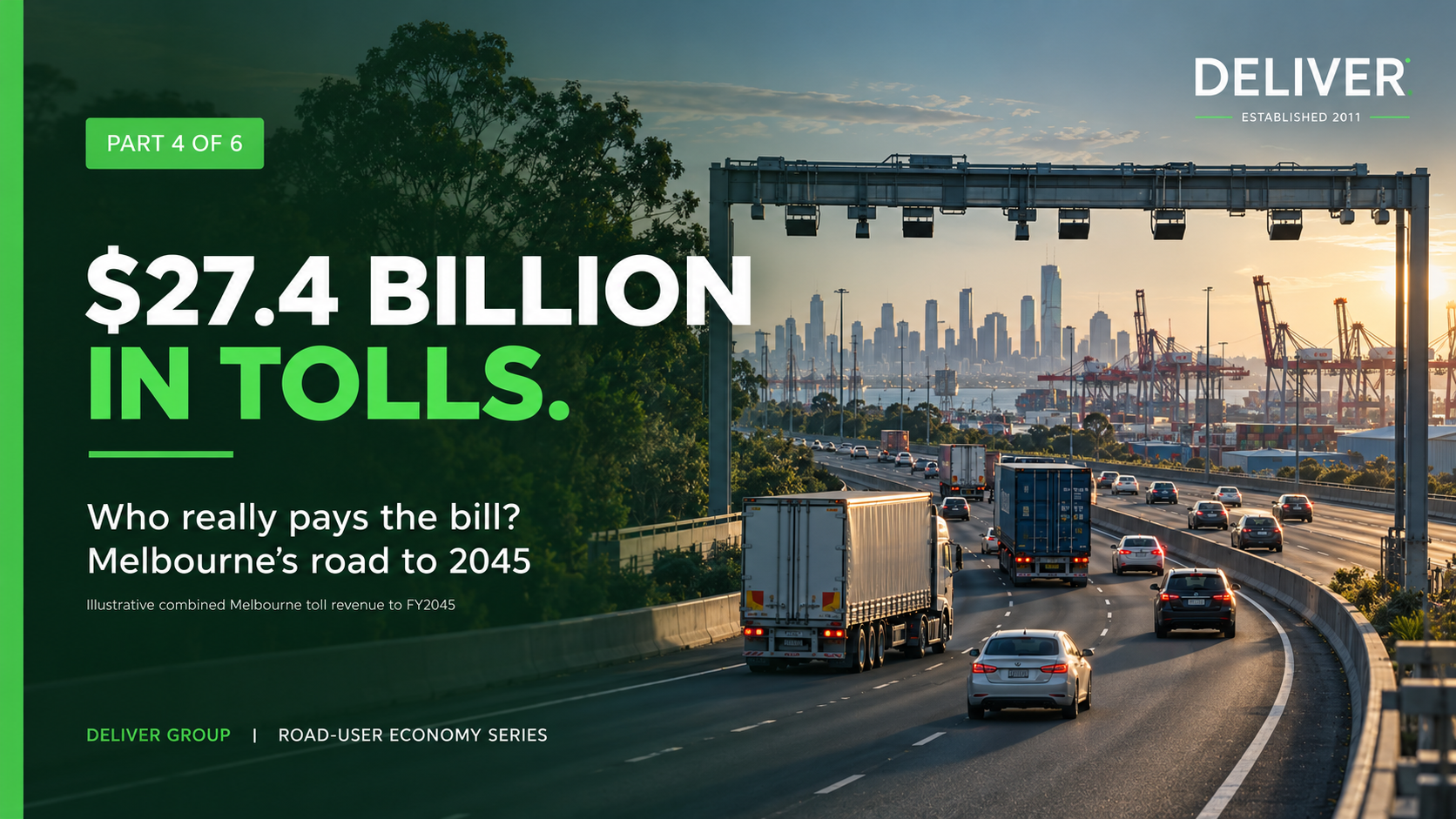
Deliver’s illustrative projection of combined Melbourne toll-road revenue, FY2027–FY2045. Not a West Gate Tunnel-only forecast or an estimate of profit.
The bill does not stop at the toll gate
A toll appears on a transport operator’s invoice. Its effects can travel much further — into freight rates, business operating costs and, where those costs are passed through, the prices paid by households.
How much is passed through depends on competition, contracts and supply-chain conditions; it is not a separately measured $27.4 billion cost-of-living increase.
A child born when the agreement was signed in 2017 will be around 28 when the principal concessions expire in 2045.
That is the intergenerational question at the centre of this article: what will Victorians receive for a long period of indexed toll collections?
Part 3 examined individual journeys and the productive time recovered. Part 4 looks at the much larger commercial commitment: public contributions, tolling rights, concession extensions and the value delivered to road users.
First, correct the starting numbers
The frequently repeated suggestion that the Victorian Government initially contributed $5 billion or $6 billion is not supported by the published project documents.
The original 2017 project had a stated nominal cost of approximately $6.689 billion. The Victorian Auditor-General reported an original State funding contribution of $2.661 billion.
Following construction and commercial difficulties, a further settlement was documented in 2022. The State contributed an additional $1.9 billion and Transurban contributed an additional $2.2 billion.
This takes the State’s identified contributions to approximately $4.561 billion, before considering the wider value of land, existing infrastructure, concession rights and other commercial arrangements.
Transurban originally described its project cost as approximately $4.0 billion.
Following the settlement, its published project cost increased to approximately $6.0 billion and was reported at approximately $6.1 billion in its FY2025 results.
The published funding components are:
Original State contribution: approximately $2.661 billion. The 2017 nominal State funding contribution.
Additional State contribution: approximately $1.900 billion. The 2022 settlement contribution.
Total identified State contributions: approximately $4.561 billion. The combined published contributions.
Transurban project cost: approximately $6.100 billion. The latest reported approximate project cost.
These figures should not simply be added and described as one project price. They arise from different project stages and include changes to funding and commercial risk.
They nevertheless show that this was neither a privately funded road delivered without taxpayer support nor a conventional publicly funded road.
What was exchanged for the investment?
The original funding structure relied on four main sources:
New tolls on the West Gate Tunnel and upgraded West Gate Freeway.
Adjustments to CityLink tolls during the existing concession period.
A ten-year extension of the CityLink concession from 2035 to January 2045.
A direct State contribution.
One of the most commercially significant changes was a fixed annual CityLink toll escalation rate of 4.25 per cent for ten years from July 2019.
The concession extension then gave Transurban the right to continue operating CityLink for a further decade to 2045.
That does not mean Transurban was simply handed ownership of Melbourne’s existing freeways.
The State’s financial reports describe CityLink land and road infrastructure as being leased during the concession period. The concession provides operating and tolling rights; it does not convert the underlying public road network into a permanently owned Transurban asset.
The distinction matters, but so does the commercial substance. A long concession extension and indexed toll stream have considerable value because road users have limited substitutes — particularly freight operators whose origins, destinations and delivery windows are fixed.
Was the West Gate Bridge given to Transurban?
The available project documents do not support the statement that ownership of the West Gate Bridge was transferred to Transurban.
The bridge remains part of the public road network and continues to be untolled for cars and other light vehicles. However, the project introduced heavy-commercial-vehicle tolls on the upgraded West Gate Freeway.
A heavy vehicle passing the West Gate Freeway toll point between Millers Road and Williamstown Road can therefore incur a toll even when it continues toward the West Gate Bridge rather than entering the new tunnel.
For freight businesses, that is the important commercial reality: a previously untolled movement through the corridor can now attract a charge because of the tolling point applied to the upgraded freeway — not because the bridge itself was transferred or structurally rebuilt as a privately owned asset.
Accuracy makes the commercial question stronger: the bridge was not given away; however, some heavy vehicle movements using its approach corridor became newly tolled.
Does Transurban control Victoria’s fine system?
It would also be inaccurate to say that Transurban was given unrestricted access to, or control of, Victoria’s enforcement system.
Transurban and Linkt administer ordinary tolls, passes, matching and initial notices. If an unpaid toll matter remains unresolved, it can ultimately progress into Victoria’s statutory toll-infringement process.
At that point, the matter is dealt with through government enforcement arrangements.
The operator therefore benefits from access to a legislated recovery pathway, but it does not independently issue or control government infringement penalties.
The more appropriate policy question is whether the escalation pathway is proportionate, transparent and sufficiently capable of distinguishing deliberate non-payment from account, registration, address or administrative failures.
The current revenue scale
Transurban reported $531 million of proportional Melbourne toll revenue for the six months to 31 December 2025. Annualised, that equates to a current Melbourne portfolio run rate of approximately $1.062 billion.
This is not a mature West Gate Tunnel revenue figure. The tunnel opened on 14 December 2025 and contributed for only a small part of the half year. The reported amount also includes the much larger pre-existing CityLink business.
Accordingly, the $1.062 billion figure should not be described as annual West Gate Tunnel revenue. It is a useful indication of the present scale of Transurban’s combined Melbourne toll-road portfolio.
An illustrative view to 2045
To show the order of magnitude — not to forecast Transurban’s audited project return — Deliver modelled the current Melbourne revenue run rate through to the January 2045 concession expiry.
The illustration assumes:
A starting annual Melbourne toll-revenue run rate of $1.062 billion.
Revenue escalation of 4.25 per cent through FY2029 and 2.5 per cent annually thereafter.
No additional traffic growth.
A constant 87.7 per cent operating EBITDA margin, matching Transurban’s reported Melbourne margin for 1H FY2026.
A modelling period from FY2027 to FY2045.
Using a Transurban project cost of $6.1 billion for scale comparison, the illustrative portfolio measures are:
Nominal Melbourne toll revenue to FY2045: $27.4 billion.
Indicative operating EBITDA: $24.0 billion.
Indicative EBITDA multiple: 3.93 times.
Simple nominal return before financing, tax and lifecycle costs: 293%.
Indicative nominal recovery of $6.1 billion: around FY2032.
The calculation is deliberately transparent, but it is not a project valuation and should not be represented as Transurban’s actual return on the West Gate Tunnel.
Most importantly, CityLink revenue through 2035 already belonged to Transurban under its existing concession. The new agreement did not create all of that revenue.
The incremental economics of the deal comprise the changed escalation arrangements, the new West Gate Tunnel and West Gate Freeway tolls, and the additional CityLink operating period from 2035 to 2045.
EBITDA is also not free cash flow. The illustration does not deduct financing costs, tax, maintenance, future capital expenditure or concession amortisation, and it treats Transurban’s progressively funded investment as though it were one comparison amount.
The $27.4 billion figure is a scale test: it illustrates how much revenue the combined Melbourne portfolio could collect, not how much profit the West Gate Tunnel deal alone will produce.
Why did the Government consider the deal justified?
The Victorian Government’s stated case was not simply financial. It argued that the project would provide:
A second major river crossing and an alternative to the West Gate Bridge.
Additional capacity on the West Gate Freeway.
Faster and safer access to the Port of Melbourne.
The removal of thousands of trucks from residential streets.
Improved network resilience and incident response.
New cycling connections and open-space improvements.
Private-sector acceptance of patronage, operations and maintenance risks.
The Government’s published assessment concluded that the proposal represented value for money and allowed Transurban’s CityLink revenue base and operating systems to support delivery without the State financing the entire project itself.
Those are legitimate considerations. A second crossing, stronger freight connections and removal of trucks from local streets can create substantial economic and community value.
What did the Auditor-General find?
The Victorian Auditor-General did not conclude that the project had no value. It found that the Department of Treasury and Finance’s quantitative assessment complied with the relevant market-led-proposal requirement and that the Government had been advised the proposal represented value for money.
However, the Auditor-General also found that the advice was not sufficiently comprehensive.
The identified weaknesses included limited analysis of alternative funding and delivery options, wide benchmark ranges without a best estimate, insufficient sensitivity analysis and inadequate disclosure of key assumptions.
The audit also observed that the public-interest assessment did not adequately examine how tolling costs and benefits would be distributed among different road users, including the freight and logistics sector and heavy vehicles using the existing West Gate Bridge corridor.
From a business perspective, that omission is material. A project can produce a positive whole-of-network result while still imposing disproportionate costs on particular customers.
What does Victoria’s next generation receive?
A child born when the agreement was signed in 2017 will be approximately 28 years old when the principal concessions expire in 2045.
Many young Victorians will therefore spend the first decades of their working lives paying indexed tolls directly or indirectly through freight rates, product prices and household costs.
They should also inherit productive infrastructure: the tunnel, widened freeway, port connections, cycling facilities and a more resilient western transport corridor. The West Gate Tunnel is required to transfer back to the State in January 2045, subject to the contractual handback requirements.
The intergenerational test is therefore not whether infrastructure exists at the end. It is whether the total value created during and after the concession exceeds the combined cost carried by taxpayers, road users, freight businesses and consumers.
The next generation should inherit more than an asset; it should inherit infrastructure whose productive value exceeds the financial obligations used to create it.
How would Deliver assess the arrangement?
Deliver would assess a customer supply-chain investment by comparing total cost with measurable service and productivity outcomes. The same discipline should apply here.
At a minimum, the road network’s customers should receive transparent reporting on:
Actual traffic volumes by vehicle class, corridor and time of day.
Measured journey-time savings against realistic untolled alternatives.
Journey reliability and incident-recovery performance.
Freight productivity and port-access improvements.
Truck reductions on nominated residential streets.
Toll revenue, escalation and the remaining concession value.
The distribution of costs across motorists, freight operators, businesses and households.
Whether prices should change when the promised service value is not delivered.
This would shift the conversation from revenue collection to customer value. It would also allow Victorians to see whether the arrangement is delivering what was promised — and whether that value is being shared fairly.
The commercial question
The West Gate Tunnel and CityLink arrangements should not be dismissed simply because Transurban can earn a commercial return.
Private capital will not fund major infrastructure without one.
The concern is whether the State secured the best available structure, whether alternative funding models were properly assessed, whether the distribution of costs was fair and whether customers will receive value proportionate to what they are required to pay through to 2045.
That remains the central Deliver question:
Not simply how much revenue can the road network generate, but how much measurable value does it deliver to the customers who fund it?
Sources and calculation notes
Victorian Department of Treasury and Finance: West Gate Tunnel Project Summary.
Victorian Auditor-General’s Office: Market-led Proposals: West Gate Tunnel.
Victorian Government: West Gate Tunnel settlement and project information.
Transurban: 1H FY2026 Results Presentation.
Transurban: FY2025 Results Presentation.
State of Victoria: 2023–24 Financial Report — CityLink concession arrangements.
Calculation note: All projections are illustrative nominal calculations prepared by Deliver using the assumptions expressly stated in the article. Totals may differ slightly because of rounding. They are not Transurban guidance, an independent valuation or an audited forecast. The assumed pass-through of freight toll costs to consumers is discussed qualitatively, not quantified.