
The Parking Fine Paradox!
Part 1 of Deliver’s 6-part series on the cost of moving across Victoria
Are We Managing Parking or Driving Customers Away from Local Business?
Parking rules are necessary - The real question is whether enforcement remains focused on access, safety and fair turnover - or whether the financial risk of parking is beginning to change - where customers choose to spend.
For most of us, parking is simply part of everyday life.
We park to buy a coffee, attend a medical appointment, collect groceries, meet someone for lunch, visit a client or support a local retailer.
But across Melbourne, parking is increasingly becoming something else: a financial risk that must be considered before we decide whether to stop at all
The question is no longer only: “Can I find a parking space?” It is increasingly: “Can I afford the risk of parking there?”
That may sound dramatic, but when a short visit can result in a substantial fine because a customer misunderstood a sign, overstayed by several minutes, selected the wrong zone or entered an incorrect registration number, the potential penalty can be disproportionate to the purchase they intended to make.
Would you risk a significant parking fine to buy a $6 coffee?
Would you visit a local shopping strip for a $30 purchase when the conditions are confusing, or would you choose a shopping center with free parking and predictable experience?
This creates what could reasonably be described as a “parking-risk tax” on physical retail. The cost is not only borne by the person who receives the fine. It can flow through to retailers, hospitality operators, employees, commercial landlords and the wider local economy.
Parking Management Has a Legitimate Purpose!
Parking controls are necessary.
Without sensible time limits and enforcement, commuters and residents could occupy valuable shopping-strip spaces throughout the day, leaving no convenient access for customers.
Effective parking management can create turnover, prevent short-term spaces being occupied all day, protect loading and accessible areas, and make limited public space available to more people.
The issue is therefore not whether parking rules should exist. It is whether enforcement remains focused on access, safety and reasonable turnover or becomes overly rigid, automated and financially dependent on infringement income.
Reasonable parking management can support retailers - Aggressive fine generation can hurt them.
The Hidden Parking-Risk Cost!
The cost of parking is not limited to the meter or mobile application. It also includes the possibility of receiving a substantial fine because a customer misunderstood a sign, overstayed by several minutes, entered the wrong registration number, selected the wrong zone, returned late from an appointment or was delayed inside a business.
When the possible fine is several times larger than the intended purchase, the customer may reasonably decide the visit is not worth the risk. No formal tax is paid unless an infringement is issued, but the perceived financial exposure can still influence where people shop, how long they stay and whether they visit at all.
Customers may avoid the precinct, stay for less time, visit fewer stores, choose shopping centres with free and predictable parking, or avoid restaurants, appointments and other services where the finishing time is uncertain. Over time, discretionary purchases may also shift online or to competing precincts with easier access.
The impact is particularly concerning around essential destinations that people cannot readily avoid, such as hospitals, medical centres and public-service facilities.
These locations regularly involve unexpected delays beyond the visitors’ control.
Where parking restrictions are tightly enforced around such destinations, overstays are more likely and infringement income may become financially material, creating a perception that the system is capitalising on unavoidable delays rather than supporting fair access and reasonable compliance.
The Retailer Does Not Issue the Fine - but May Still Lose the Customer!
Councils may view a parking infringement as a compliance matter between the authority and the motorist.
The customer often sees it differently. They remember the street, suburb or shopping precinct where the fine was received.
The café did not issue a fine.
The retailer did not design the signs.
The medical clinic did not determine the time limits.
Yet each may lose the returning customer.
A person who receives a substantial infringement after spending $40 at a café may associate the entire experience with the location, not merely with the parking authority.
The financial penalty is issued to the motorist - but part of the economic penalty may be transferred to the surrounding businesses.
The same behavioural response can occur before any fine is issued. If an area becomes known for confusing signage, rapid enforcement, limited grace periods or expensive infringements, customers may modify their behaviour in advance.
The fear of the fine can influence visitation even when no infringement is ultimately received.
Melbourne Has Already Seen the Retail Effect!
This concern is not purely theoretical.
A Monash University study examined the introduction of paid parking at Yarraville Village, a Melbourne retail precinct containing 107 shops and a cinema.
The research identified changes in visiting preferences, a considerable reduction in car trips, shorter stays and decreases in both grocery and discretionary expenditure.
The researchers emphasised that these effects were evident at least in the short term.
An overseas study of two Starbucks locations found that a small US$0.50 per-hour parking fee reduced observed customer traffic by almost 30 per cent when parking spaces were otherwise readily available. That finding was specific to the locations and conditions studied and should not be applied universally.
It nevertheless illustrates how even modest additional cost and friction can deter low-value, convenience-based visits.
For local business, customer behaviour does not need to change dramatically for the consequences to become material. A modest reduction in visitation, combined with shorter stays and fewer stores visited, can have a significant cumulative impact across an entire shopping strip.
The Fine Is Often Disproportionate to the Error!
Public frustration is heightened when the conduct being punished appears minor or accidental.
The Victorian Ombudsman found that the City of Melbourne had acted unfairly by upholding fines against drivers who had paid for parking but made simple registration-entry mistakes in the PayStay application.
Some motorists confused the number zero with the letter O characters that were effectively indistinguishable on Victorian registration plates. The Ombudsman estimated that more than 1,200 motorists were affected and described the approach as overly rigid.
Most people accept that deliberately parking illegally, blocking access or occupying a restricted space should have consequences.
They are less accepting when a customer has paid, attempted to comply and made a genuine administrative mistake, yet is treated in the same manner as someone who deliberately ignored the rules.
A fair enforcement system recognises the difference between deliberate non-compliance - and an honest error.
Penalty Values Continue to Rise!
Over the past decade, Victoria’s penalty-unit value has risen from $155.46 in 2016–17 to $209.10 in 2026–27, an increase of $53.64, or 34.5 per cent.
The largest single rise occurred in 2021–22, when the value jumped by 10 per cent. Not every parking fine equals one full penalty unit, but penalties linked to this framework can continue increasing even when the seriousness of the underlying offence has not changed.
At a time when households are already dealing with higher costs for housing, insurance, energy, food and transport - the risk of an additional parking fine becomes another factor - influencing discretionary spending.
Parking Enforcement Has Become a Significant Revenue Stream!
Council financial reports demonstrate that parking and infringement activity now produces substantial income.
An initial review of four metropolitan councils identified approximately $84.5 million in reported parking- and infringement-related income during 2024–25. The published figures are summarised below
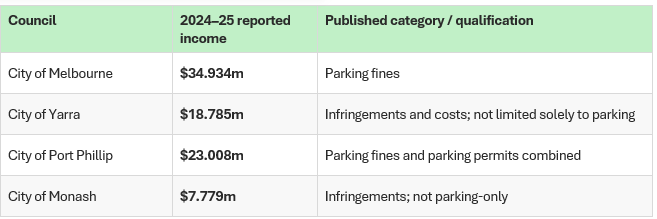
Even with those qualifications, the scale is significant. Parking enforcement is no longer a minor administrative activity; it is financially material within several council budgets.
This creates an inherent policy tension. A successful parking system should produce high voluntary compliance, fair access and appropriate turnover. In theory, better compliance should lead to fewer fines.
Yet when councils budget for millions of dollars in infringement income, the financial benefit of enforcement can become structurally embedded in annual planning.
The public should therefore be shown not only the number and face value of fines issued, but also the cash actually collected, the amount withdrawn or written off, enforcement and contractor costs, and the net income retained by each council.
That transparency would allow the community to assess whether technology is primarily being used to help motorists comply or to make technical breaches easier and more profitable to detect.
Parking Fees Are Generally Additional to Fine Revenue!
Parking-meter and app payments are generally a separate income stream from parking fines. Councils can therefore receive revenue when a motorist complies and pays to park, and additional revenue when a motorist fails to comply and is fined.
For example, the City of Melbourne reported $36.452 million in parking fines and $48.602 million in parking fees in 2023–24 - a combined $ 85.054 million across the two streams.
This is why the $ 84.506 million four-council figure should not be described as the total parking economy. It captures selected fines, infringement and permit categories, not all parking charges received by councils.
The fine income is only one part of the equation: councils generally earn when motorists comply and pay to park - and earn again when motorists fail to comply and are fined.
Are We Encouraging People to Shop Online?
Parking fines alone are not responsible for the growth of online shopping. Online purchasing has expanded because it is convenient, offers broad product choice and allows customers to compare prices without travelling. Aggressive parking enforcement can, however, make that comparison even easier.
Physical retail asks the customer to travel, find a space, understand the signs, pay correctly, monitor the time and accept the possibility of a significant fine if anything goes wrong. Online retail asks the customer to open a phone.
When visiting a local business becomes unnecessarily difficult or financially risky, online shopping becomes one of several more attractive alternatives. Others include major shopping centres with free and predictable parking, home delivery, click-and-collect and precincts that offer easier access.
Aggressive parking enforcement does not create online shopping, but it can remove another reason for customers to choose physical retail.
The CBD and Suburban Shopping Strips Are Different!
The effect will not be the same everywhere.
City of Melbourne transport material, drawing on VISTA 2016 data, reported that only 14 per cent of shoppers in the municipality parked on the street, while 73 per cent arrived using non-car modes. That helps explain why the central city cannot automatically be compared with car-dependent suburban shopping strips, medical precincts or neighborhood centres.
A CBD retailer may receive substantial pedestrian, tram and train traffic. A suburban café, specialist retailer, allied-health provider or restaurant may rely heavily on customers being able to park nearby.
Parking policy should recognise those differences rather than applying a single enforcement philosophy to every commercial area.
Are there Better Ways to Manage Parking?
A customer-friendly system does not require councils to abandon parking restrictions or appropriate enforcement. It requires parking policy to remain focused on its original purpose: creating fair access, encouraging reasonable turnover and helping customers comply with the rules.
Public records show that councils have invested in in-ground sensors, digital monitoring, licence-plate recognition and more efficient infringement administration.
Monash, for example, awarded a broad parking and enforcement services contract estimated at approximately $22.57 million over six years. The contract was not a pure technology investment, but it illustrates the scale of modern parking operations.
Yarra’s 2016–17 annual report described a sensor program intended ultimately to cover approximately 4,000 bays.
These facts do not prove that technology was introduced to maximise revenue. Sensors and digital systems can improve availability data, turnover and compliance.
They do, however, demonstrate the significant operational and financial infrastructure now built around parking enforcement.
The same technology could be used differently. A warning-first system could send an optional text or app notification when a driver has 15 minutes remaining, allow a simple extension where lawful, or direct the driver to nearby longer-stay parking.
For app users and digital permit holders, the communication channel already exists. For free timed spaces, councils or the state could offer a voluntary registration service with appropriate privacy safeguards.
This could be supported by clearer and more consistent signage, easy payment systems, reasonable grace periods, warning-first approaches for low-risk first offences and discretion where a customer has been delayed by medical treatment or another circumstance beyond their reasonable control.
This approach is already recognised in principle by the City of Melbourne.
Its Parking and Curbside Management Plan says enforcement should prioritise behaviour change and voluntary compliance, anticipates that simpler controls could reduce fines by up to 10 per cent, and expressly states that an increase in parking fines should not be regarded as a measure of success.
In late 2025, the City of Melbourne also introduced up to 15 minutes of free parking in eligible paid bays when motorists start a session through the EasyPark application. It is a practical example of reducing friction for short visits while maintaining a managed parking framework.
Technology should be used first to assist with compliance and manage access, not simply to identify and monetise every technical overstay.
What Should Success Look Like?
The success of parking management should not be measured by the number of fines issued. It should be measured by whether:
customers can find an appropriate space;
vehicles turn over at a reasonable rate;
loading and accessible areas remain available;
people understand the rules;
local businesses remain accessible; and
deliberate non-compliance is reduced.
An effective system should ideally generate fewer infringements over time because signs, systems and public understanding are improving.
When infringement income becomes an expected and material part of a council’s finances, a reasonable policy question arises
Does the authority still have a strong financial incentive to design a system in which fewer people are fined?
This does not mean councils are acting unlawfully or intentionally harming business. It does mean that transparency, proportionality and independent oversight become increasingly important.
From a Logistician's Viewpoint
From a logistician's viewpoint, the logic and value of parking enforcement should be tested in the same way we would review a customer's operating process: what is the objective, what does the system cost in total, what measurable value does it create and what unintended impacts does it produce?
Parking enforcement clearly has value when it improves safety, access and turnover, but a system that can detect a breach instantly while making little effort to prevent it deserves to be challenged.
If warnings, clearer rules, proportionate escalation and better technology can achieve compliance while reducing fines, protecting local trade and maintaining public access, that is the higher-value outcome.
The question is not whether enforcement should exist, but whether the current model delivers the best overall result for motorists, businesses and the community - or simply the most reliable revenue.
Selected sources and methodology.
1. Monash University – Yarraville paid-parking study
2. Hymel (2014) – Parking fees and Starbucks traffic
3. Victorian Ombudsman – City of Melbourne parking-fine review
4. Victorian DTF – Fees and penalty-unit indexation
5. City of Melbourne – 2024–25 Annual Report
6. Yarra City Council – 2024–25 Annual Report
7. City of Port Phillip – 2024–25 Annual Report
8. City of Monash – 2024–25 Annual Report
9. City of Melbourne – Parking and Kerbside Management Plan
10. City of Monash – Parking and Enforcement Services tender
11. Yarra City Council – Parking sensors
12. City of Melbourne – Kerbside parking and fees
13. City of Melbourne – 2023–24 Annual Report
Methodology notes: The $84.506 million figure is a simple sum of four councils published 2024–25 revenue categories. It is indicative only. The categories are not uniform and do not represent consolidated cash collected or net parking-fine profits.