
Victoria's Expanding Fine Economy.
When Safety Enforcement Starts to Look Like a Revenue System.
ABOUT EVERY 17 SECONDS, Victoria's State fine system processes another infringement notice.
In just one year, Fines Victoria processed 1,832,840 notices while the State recognised approximately $680 million in fine income. That is not a small compliance program. It is a large, permanent and highly automated financial machine.
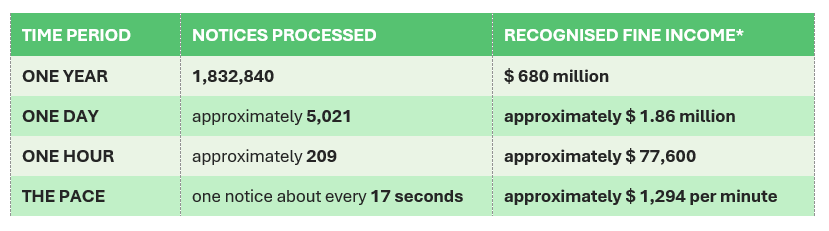
* Recognised fine income is an accurate accounting figure. It should not be described as the amount of cash collected during the year.
The $ 680 million is recognised accounting income, not a published whole-of-system cash-collection total. Victoria does not provide one transparent annual statement showing the total cash collected across State agencies and councils, an information gap that becomes more significant as the system grows.
Most Victorians support penalties where the safety purpose is clear.
The central question is whether a machine of this size is still designed principally to change behaviour or whether enforcement has also become an automated and financially embedded revenue system.
THE CENTRAL QUESTION?
Is Victoria still operating a system to change behaviour ? or one that has also become structured to collect recurring revenues?
That is what we mean by Victoria's expanding fine economy. Although this article examines Victoria, the cost also reaches interstate carriers, national supply chains and families around Australia through administration, freight rates and delivered prices.
What Is the Fine Economy?
A fine is legally different from a tax.
A tax is generally imposed across a section of the community to fund government services. A fine is imposed because a person or business is alleged to have breached a law or regulation.
From a household or business perspective, however, the practical distinction can become less clear when fines:
increase through statutory indexation;
generate hundreds of millions of dollars;
are incorporated into government and council budgets;
are issued through increasingly automated technology;
attract additional reminder and enforcement charges; and
become an expected source of recurring public revenue
The fine economy is not one particular speed camera, parking officer or infringement notice.
It is the broader financial and administrative ecosystem surrounding detection, issuing, processing, internal review, payment, late fees, debt recovery, court escalation and enforcement.
It extends across road-safety cameras, police-issued traffic fines, toll evasions, parking infringements, public-transport offences, court fines and other statutory penalties.
Victoria Recognised $680 Million in State Fine Income
Victoria's audited 2024-25 Financial Report recognised approximately $680 million in fines income, about $1.86 million for every day of the year.
That was lower than the $ 750 million recognised in 2023-24, but it remains a financially material State revenue stream.
The State figure includes road-safety camera fines, toll-road evasions, police-issued infringements, court fines and other statutory penalties.
IMPORTANT ACCOUNTING DISTINCTION
The $680 million is revenue recognised when notices are issued. It is not the precise amount of cash collected during the same financial year.
It does not include all parking and other infringement income recognised separately by councils. The key issue is therefore both the size of the confirmed $680 million State figure and the absence of one transparent total for the whole Victorian system.
Revenue Recognised Is Not Cash Collected
A fine may be paid, reviewed, withdrawn, placed on an arrangement, left outstanding or eventually written off. Government accounts can therefore recognise income before the cash is received.
That does not make the revenue figure unimportant; it means public reporting must distinguish notices issued, revenue recognised, cash collected, cancellations, outstanding debt, added fees, collection costs and the net amount retained.
Fine Values Continue to Increase!
Many Victorian penalties are linked to an indexed penalty unit. Its value increased from $151.67 in 2015-16 to $209.75 in 2026-27 - approximately + 38%.
Indexation means the dollar penalty can rise even when the underlying conduct has not become more serious. That is a structural feature of the system, not proof of an improper motive, but it increases the financial impact on households and businesses.
The State System Operates at Enormous Scale
Fines Victoria processed 1,832,840 infringement notices in 2024-25, an average of more than 5,000 every day.
The central system covers camera-detected road offences, toll infringements, police-issued matters, court fines and other statutory penalties.
Technology enables continuous detection and processing at a scale that traditional officer-based enforcement could never achieve.
Automation can improve consistency and reach. But once detection and processing become scalable, volume is no longer limited by the number of officers available.
That creates a higher obligation to provide accurate evidence, accessible review, independent oversight, proportionality and genuine human discretion.
THE PRINCIPLE
Automation should improve fairness - It should not make unfairness more efficient.
The Central Policy Tension
Victoria Police reported that 99.8% of drivers tested by road-safety cameras complied with posted speed limits in 2024-25.
That is the result a safety system should want: almost everyone complying. If nobody speeds, runs a red light, uses a phone illegally or evades a toll, the system has achieved its purpose, but fine revenue must fall.
The test is simple: would falling infringement revenue be celebrated as safer behaviour, or treated as an adverse budget result?
Safety enforcement and financial material revenue can exist at the same time. The safeguard is ensuring that safety and compliance remain the dominant objectives.
A Successful System Must Survive Its Own Success
Government must be able to fund essential services without relying on continuing non-compliance. A successful safety and compliance system should be financially capable of surviving its own success.
THE UNCOMFORTABLE QUESTION
If every Victorian complied tomorrow, would that be celebrated as a safety achievement - or treated as a budget problem?
The Fine Is Not Always the Final Cost
An infringement becomes much more expensive if it is not dealt with by the due date.
From 1 July 2026, an unpaid infringement can attract a $ 30 penalty-reminder fee, a further $ 155.60 at final demand and another $ 68 when an enforcement warrant is issued.
That adds $ 253.60 to the original amount. A $ 200 fine can become $ 453.60 before other consequences; several unresolved fines can quickly become thousands of dollars and may lead to licence or registration sanctions, wheel clamping or property recovery.
The escalation can fall hardest on people facing financial hardship, unstable housing, family violence, limited English or administrative difficulty, the people most likely to struggle with the first notice.
Victoria provides instalments, extra time, Work and Development Permits and the Family Violence Scheme. Those protections matter, but added administrative charges should remain proportionate to the original conduct.
The Same Fine Does Not Have the Same Impact!
A $ 300 fine has the same face value for everyone, but not the same practical effect. It may be manageable for a high-income household and compete with rent, food or power for somebody on a low income.
For a transport operator, courier or trades business, multiple vehicle notices also create nomination work, administration, operational disruption and costs that ultimately flow to customers.
THE EQUITY QUESTION
Flat fines are equal in face value - They are not necessarily equal in punishment.
A credible deterrence system must be strong enough to influence behaviour, proportionate to the risk and fair in its real economic effect.
Is It Really a Hidden Tax?
Legally, no. A fine is a penalty for an alleged offence, and most fines can be avoided by following the rules.
The concern is practical: indexed penalties, budget forecasts, automated detection and escalating recovery charges can make the system resemble an embedded conditional revenue framework.
The issue is not that revenue exists. It is whether government has become financially dependent on a level of offending that the system is supposed to reduce.
A CONDITIONAL REVENUE SYSTEM
Not a traditional tax, but an increasingly material form of government revenue imposed on people and businesses alleged to have made an error or breached a rule.
What a Fairer State System Would Look Like
Safety first
Enforcement locations and priorities should be tied to demonstrated safety risks. Revenue must remain a by-product, not the objective.
Proportionate penalties
Responses should distinguish dangerous or repeated conduct from low-risk first offences and genuine administrative mistakes.
Warnings where appropriate
A warning may change behaviour more effectively than an immediate fine for an eligible low-level first offence. Serious conduct should remain excluded.
Human discretion
Review officers must be able to recognise system errors, hardship, reasonable attempts to comply and deliberate non-compliance.
Independent review
A challenge should receive a genuine and impartial review, not a process designed mainly to confirm the original decision.
One transparent annual statement
Victoria should publish notices issued, revenue recognised, cash collected, cancellations, warnings, outstanding debt, added fees, collection costs, net proceeds and how the money was used.
Measure success by fewer offences
If infringement revenue falls because people are following the rules, that should be reported and celebrated as success.
Are Victorians Becoming Safer or Simply Paying More?
The honest answer may be both.
Targeted enforcement can reduce dangerous behaviour. But Victoria has also built a highly automated system that recognised $680 million in State fine income and processed 1.83 million notices in one year.
The public still cannot see the whole system - revenue, cash, cancellations, unpaid debt, added fees, collection costs and council income - in one transparent statement.
The issue is not whether enforcement should continue. It should.
The issue is whether a financially material system has enough transparency, proportionality, discretion and independent oversight.
Professional drivers, freight carriers, tradespeople, commuters, parents and local shoppers all encounter the same framework.
Most will support enforcement that clearly makes roads safer. They are equally entitled to ask whether every expansion is driven by safety- or whether recurring revenue has become part of the equation.
From a Logistician’s Viewpoint
A logistics operation processing 1.83 million transactions a year and generating $680 million in recognised income would be expected to provide clear reporting on volumes, revenue, collections, cancellations, operating costs, outstanding debt and customer outcomes.
Victoria’s fine system does not yet provide that complete view.
The figures equate too approximately:
5,021 notices processed every day
209 notices every hour
One notice approximately every 17 seconds
$1.86 million in recognised fine income every day
An implied average of approximately $371 per notice processed
These are the characteristics of a substantial, highly automated revenue operation - not a minor administrative function.
Enforcement remains necessary. Dangerous driving must have consequences.
But a system designed to improve behaviour should ultimately produce fewer offences, fewer fines and lower revenue. Its success should be measured by safer roads, not by the continuing financial output of the enforcement machine.
From a logistician’s viewpoint, the test is straightforward:
If Victoria cannot clearly report the full cost, income and outcomes of a system operating at this scale, it cannot convincingly demonstrate that safety - not revenue - remains its primary measure of success.
THE FINAL TEST
A safety system should reduce offending- even when doing so reduces its own revenue.
That answer tells us whether Victoria has a compliance system- or a fine economy.
Sources and Methodology.
This article draws primarily on official Victorian Government, parliamentary, police and Fines Victoria material available as of 3 September 2026. State fines income is reported on an accrual basis and should not be confused with cash collected.
• Victorian Department of Treasury and Finance - 2024-25 Financial Report
• Victorian Department of Treasury and Finance - Indexation of fees and penalties
• Sentencing Advisory Council - Historical penalty-unit values
• Victorian Parliament - DJCS 2024-25 performance questionnaire
• Victoria Police - 2024-25 annual report performance measures
• Fines Victoria - If you don't deal with your fine; fee stages current from 1 July 2026